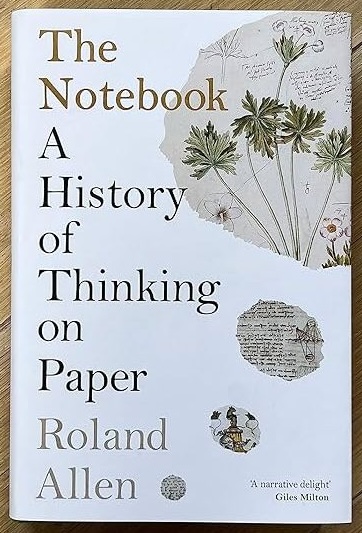
Author
Roland Allen
Published
2024
First read
October 2024
Whoever has no notebook in their sleeve will note establish wisdom in their heart.
I ordered this book as soon as I saw it. While I love computers, I’m devotedly analog for notes, journals, etc. A history of notebooks is right up my alley.
Rather than any attempt at a summary, these notes are simply what stood out to me while reading.
Paper appealed to Italian merchants of the 1200s because it was permanent. They were the first to use notebooks, driven by the switch from parchment (treated animal skins) to paper. Parchment could be scraped clean which opened the door for fraud, but paper ledger books were harder to modify.
Sketchbooks contributed to a huge improvement in the quality of art as they made it easier for artists to prepare works and has out early stage ideas. Once I read through this section it was one of those, “Huh, well of course!” things that hadn’t occurred to me before. If material is scarce and expensive then you lose the ability to iterate through ideas.
For Dante to become widely read, universally celebrated and the foundation of a new literature — in short, for Dante to become Dante — scribal reproduction would not alone suffice. His writings were transmitted to a much larger, more diverse, audience, by thousands of ordinary people copying favourite texts from zibaldone to zibaldone, reading and re-reading them at home, and sharing them with friends and family.
There’s a whole section on commonplace books (and their precursors like the zibaldone mentioned above). From one section:
the well-arranged common-place functioned as a kind of externalised memory, which, as historian Ann Blaire notes, “liberated the reader from the task of memorising the selected passages.” This in turn “freed up mental capacity for…reasoning and reflection” and was particularly useful in an age when the rate of arrival of new books far outstripped anyone’s ability to master their contents.
In northern Europe of the 1600s people kept friendship notebooks where they’d gather entries from people they knew. It’s fascinating to read as a quasi-social network app, just via paper and small notebooks.
A few miscellaneous tidbits I learned:
- Renaissance Florence had no sewers. da Vinci preferred his spiral staircases because, “the corners of square ones are always fouled.”
- The 13,000 pages of Leonardo da Vinci’s notebooks that survive are estimated to be about a quarter of the original total. “This implies that Leonardo filled his notebooks at a rate of about a thousand pages a year.”
- Agatha Christie left behind 73 notebooks that were horribly disorganized. Notes for a single book will often span multiple notebooks, with most containing notes for 5 or 6 separate books.
