Author
John Gribbin
Published
2004
First read
July 2025
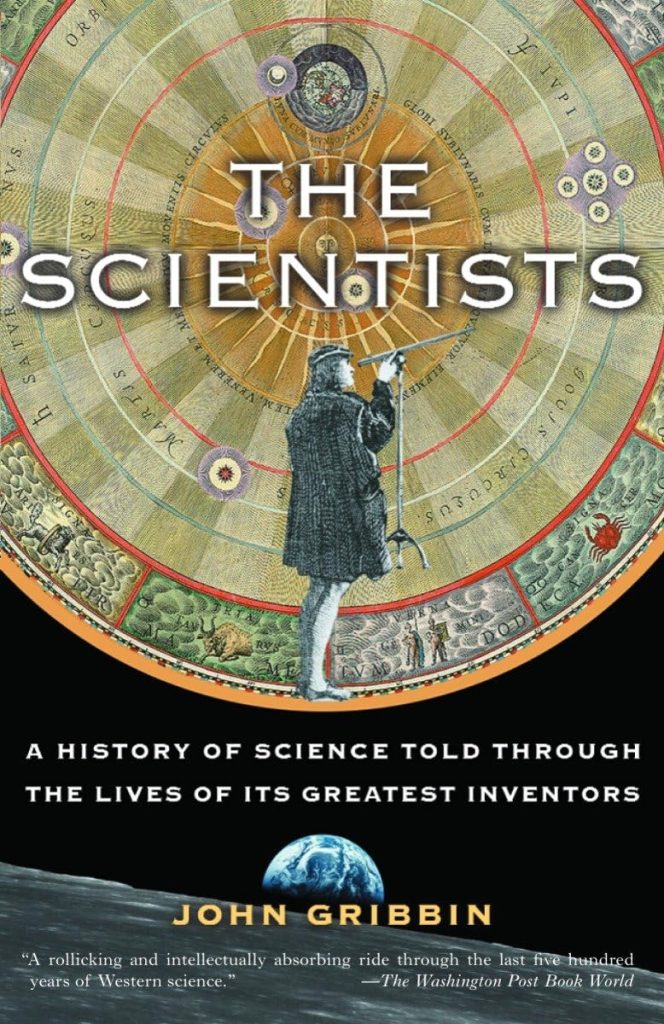
This was a fantastic read! Gribbin weaves a history of science from the Renaissance through to near present day and tells it by narrating the lives of the people who advanced the field. It’s far from a hagiography of individuals, though. Instead you get a clear sense of just how much science advances via the steady accumulation of knowledge, from one person to the next.
A few things stood out to me while reading. First, so many of these men relied upon prominent figures going outside the bounds of allowed behavior to teach them key concepts. Vesalius, an anatomist, benefited from Marcantonio Contarini, a judge who gave him bodies of recently executed criminals and sometimes delayed the timing of execution to fit in with Vesalius’s schedule. Or Kepler, as a university student, had the good fortune of learning from Michael Maestlin who taught the Ptolemaic system in class but, privately on the side, explained the Copernican system to Kepler and select others.
The divergence in how scientists credited their peers was also new to me. Isaac Newton sounds like a real jerk. Newton’s, “If I have seen further it is by standing on the shoulders of Giants” quote is arguably not as complimentary as it seems. You can also read it as a sarcastic comment on Robert Hooke (who had a severely curved back):
The message Newton intends to convey is that although he may have borrowed from the Ancients, he has no need to steal ideas from a little man like Hooke, with the added implication that Hooke is a mental pygmy as well as a small man physically.
That point of view is perhaps backed up by the fact that Newton sat on the publication of his theory of light until Hooke died, so that Hooke had no ability to contest how much of the work drew from his own research. Charles Darwin, comes across as a gracious man who said this of a forerunner:
I always feel as if my books came half out of Lyell’s brain, and that I have never acknowledged this sufficiently ….I have always thought that the great merit of the Principles was that it altered the whole tone of one’s mind.
There are also a ton of great anecdotes throughout the book. My notes file on reading runs to some 4,000 words so to pick just a few:
The symbols + and – were only introduced to mathematics in 1540, in a book by the mathematician Robert Recorde
At the beginning of August, while Galileo was still in Venice, he heard that a Dutchman had arrived in Padua with one of the new instruments. Galileo rushed back to Padua, only to find that he had missed the stranger, who was now in Venice intending to sell the instrument to the Doge. Distraught at the possibility that he might lose the race, Galileo frantically set about building one of his own, knowing nothing more than that the instrument involved two lenses in a tube. One of the most impressive features of Galileo’s entire career is that within 24 hours he had built a telescope better than anything else known at the time. Although the Dutch version used two concave lenses, giving an upside-down image, Galileo used one convex lens and one concave lens, giving an upright image.
To achieve all this and overcome what he felt to be his natural laziness, Buffon hired a peasant to physically drag him out of bed at s am each morning and make sure he was awake. For the next half-century he would start work as soon as he was dressed, stop for breakfast (always two glasses of wine and a bread roll) at 9am, work until 2pm before taking a leisurely lunch and entertaining any guests or casual visitors,’ take a nap and a long walk, then a final burst of work from 5pm to 7pm, with bed at 9pm and no supper. This dedication to hard work explains, physically, how Buffon was able to produce one of the most monumental, and influential, works in the history of science, his Histoire Naturelle, which appeared in 44 volumes between 1749 and 1804 (the last eight published, using Buffon’s material, after his death in 1788).
Highly recommend this book if you’re interested in science, history, or any combination of the two.
